
Deconvolute Your Spectral Search Results with the MSO Graph™: Taming Isomers and Isotopologues for Reproducible Annotation

Summary:
Isomers and isotopologues contribute layers of ambiguity and imprecision to the metadata in mass spectral libraries. That convolutes search results and complicates compound annotation. The MS Orchestra Graph™ contains re-curated, reorganized, and carefully expanded spectral metadata, which allow new logic in spectral search and new structure in spectral search results. MSOG’s deconvoluted search results make compound ID claims more directly comparable across experiments and searches. This innovation makes compound ID claims more reproducible, and provides a foundation for new analytical techniques.
This piece summarizes those considerations at a high level, but only as context for reviewing the underlying challenges posed by isomers and isotopologues in the process of identifying unknown compounds from high-resolution mass spectrometry data. The piece ends with a short (optional) quiz in case you want to check your own understanding and/or serve this topic up for level-setting in your lab group.
Introduction:
During any moment of data acquisition with a mass spectrometer, any molecular species may enter the instrument in several structural states at the same time. Some of those isomeric structures may produce legitimately different mass spectra, and then each of those spectra may also be associated with several different chemical identifiers (CIDs) in the chemical dictionary. In those rather common situations, whenever an operator chooses one chemical identifier to represent an unknown compound, s/he is necessarily ignoring other identifiers that could also be considered correct. By extension, several analysts who are working with mass spectra for the same compound could all assign different CIDs to that same analyte. In that case, they might all be correct, but they would certainly all be contributing to a tangle of compound ID confusion. In those situations, it can be difficult to know when different results functionally agree or disagree with each other. This ambiguity confounds human conversation, but it also confounds computational operations that could benefit from disambiguating molecular identities.
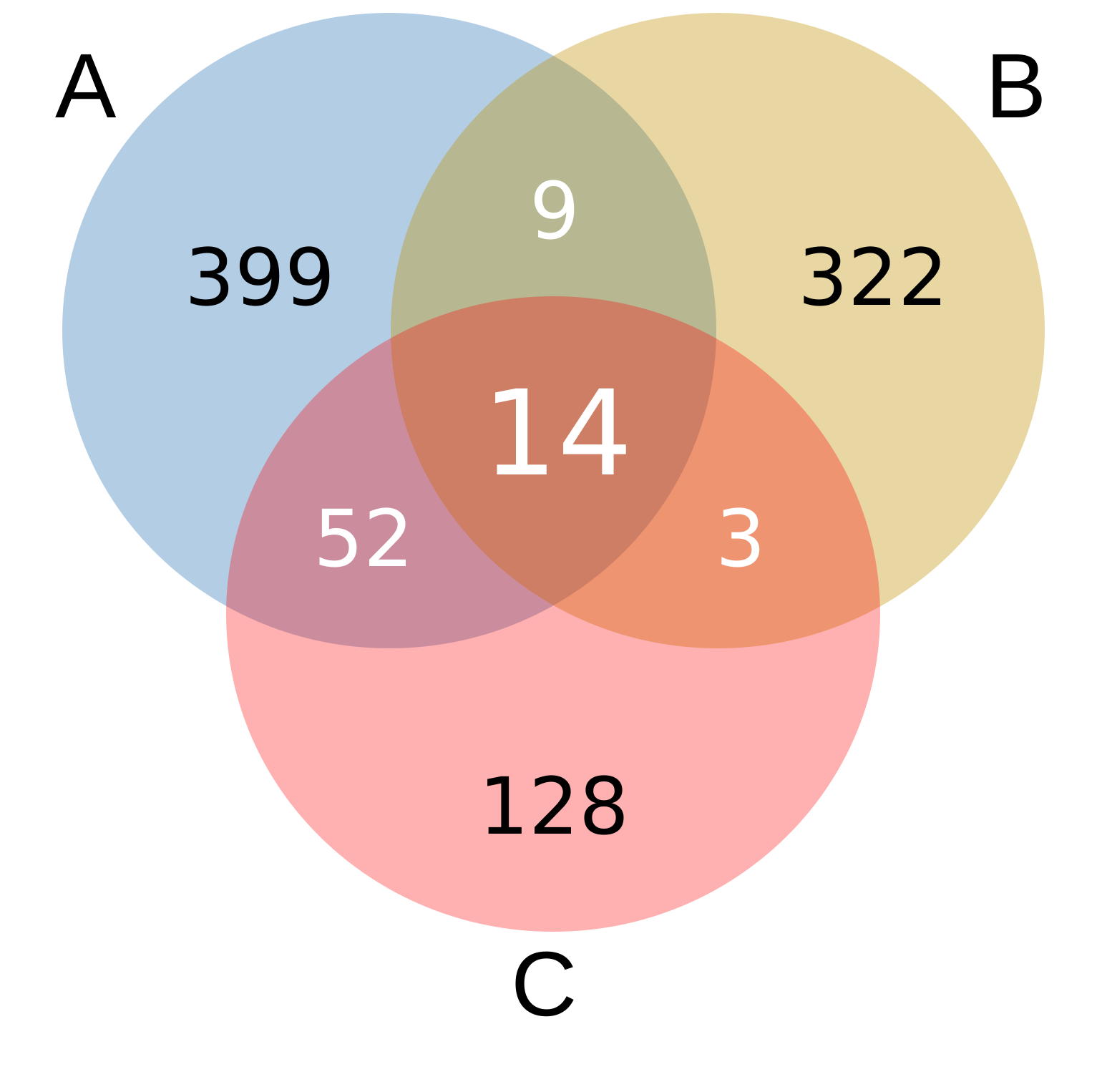
One example of this conundrum arose when chemists at the Periodic Table of Foods Initiative (PTFI) sent aliquots of the same apple juice to different lab teams, and asked them simply to identify the compounds within. In a presentation to the BP4NTA working group Steve Watkins recounted that the PTFI organizers were initially thrilled to discover that the first three labs had collectively, seemingly, identified 927 compounds. But when they dug in to compare the compound lists from those three labs, they found that fully 92% of the named compounds were only found by one lab, and only 1.5% (14 compounds) were found by all three.
That result might seem to reflect a concerning disparity of results, but the situation might actually be even worse than that. In a data analysis ecosystem where any compound might have numerous CIDs, for all the reasons outlined in this article, it might be difficult even to assess whether, when, and where the annotation results from those three labs agreed or disagreed. Analytical chemistry has a semantics challenge that makes it difficult for well-intentioned people to understand when their experimental results converge or diverge. This semantic challenge might undermine the working efficiency of the chemistry community. We write elsewhere about how the MS Orchestra Graph™ directly ameliorates this problem. The purpose of this paper is to provide a refresher on the definitions and properties of isomers and isotoplogues, so that the operations of the MSO Graph™, and the implementation of compound ensembles, may be understood more clearly in those other communications.
This piece ends with a short (optional) quiz in case you want to check your own understanding and/or serve this topic up for level-setting in your lab group.
A Primer on Isomers and Isotopologues
High-resolution mass spectrometry (HRMS) is a cornerstone of analytical chemistry, offering unprecedented precision in determining the mass-to-charge ratio (m/z) of ions. This extraordinary precision is invaluable for confidently assigning elemental compositions, which is often a critical first step in identifying unknown compounds within complex samples. However, the journey from an exact mass measurement to a definitive compound annotation is seldom straightforward. The chemical universe is far more intricate than simple molecular formulas might suggest, populated by a myriad of compounds that share identical elemental compositions yet possess distinct chemical identities.
The inherent complexity of chemical structures in nature introduces a significant challenge: the ubiquitous presence of isomers and isotopologues. On one hand these can be distinct chemical entities that, despite their subtle differences, can present deceptively similar data in a mass spectrometer. On the other hand, well-intentioned contributors to public reference libraries might submit a carefully produced mass spectrum, from a carefully purified compound, and accidentally mislabel it in the database due to the confusing nature of some isomers and isotopologues.
A thorough understanding of these nuances is helpful to achieve accurate and confident compound annotation. This summary attempts to delineate and demystify geometric isomers, diastereomers, isotopologues, tautomers, protomers, and enantiomers, clearly distinguishing them from one another. More importantly, it will explain how each of these compound types can confound or confuse compound annotation when interpreting HRMS data, and explore advanced strategies to navigate this “isomeric labyrinth.”
Definitions
The term “isomer” broadly refers to compounds that possess the same molecular formula but differ in the arrangement of their atoms.1 This overarching concept branches into two primary categories that dictate how atoms are connected and spatially oriented.
Constitutional (Structural) Isomers are compounds that share the same molecular formula but exhibit different bonding arrangements among their atoms.3 One can think of them as having entirely different “recipes” for connecting the constituent atoms. Tautomers, discussed in detail later, represent a dynamic subset within this category.
Stereoisomers, on the other hand, possess identical molecular formulas and the same sequence of bonded atoms, but their distinction lies solely in the spatial orientation of groups within the molecule.3 They follow the same “recipe” but the ingredients are arranged differently in three-dimensional space. Geometric isomers, diastereomers, and enantiomers are all important types of stereoisomers.
A fundamental challenge in HRMS arises from the fact that its primary output — the exact mass — directly leads to the determination of an elemental composition. If multiple compounds share this identical elemental composition, meaning they are isomers, then HRMS alone cannot differentiate them based solely on their molecular ion mass. This highlights a critical limitation: the initial, highly precise data point from HRMS, while powerful for elemental formula determination, is insufficient for unique identification when isomers are present. This necessitates the integration of additional analytical dimensions to resolve such ambiguities. The precise molecular weight from HRMS, while a powerful starting point, does not provide the complete structural picture, especially given the vast chemical space where isomers are prevalent. This directly impacts the confidence of annotation if only m/z is considered.
Geometric Isomers (Cis-Trans Isomers)
Geometric isomers, also known as cis-trans isomers, describe specific arrangements of atoms within molecules where rotation is restricted, typically around a double bond or within a cyclic structure.5 These compounds maintain the same connectivity but exhibit distinct spatial arrangements.6 The prefixes “cis” (Latin for “this side of”) indicate that like ligands or groups are positioned on the same side, while “trans” (Latin for “the other side of”) signifies that they are on opposite sides.5 A classic example is cisplatin (cis-Pt(NH3)2Cl2), a compound used as an anti-tumor drug, whereas its trans isomer lacks this crucial biological activity.6 This stark difference in biological function underscores how subtle geometric variations can lead to fundamentally different chemical properties. Geometric isomers are a type of stereoisomer, specifically a sub-type of diastereomers, characterized by being non-mirror image and non-superimposable.7
The fixed spatial arrangement in geometric isomers can profoundly influence their behavior in a mass spectrometer. For instance, the electron ionization (EI) mass spectra of cis– and trans-dialkyl 1,4-cyclohexanedicarboxylates have been observed to differ sharply.9 These distinctions are attributed to the conformational rigidity and steric proximity of substituents in the cis-isomers, which can dictate unique fragmentation pathways.9 Unlike other isomers where fragmentation patterns might be remarkably similar, the distinct three-dimensional structure of geometric isomers can lead to characteristic bond cleavages and ion abundances.10 Therefore, while HRMS alone might yield the same exact mass for geometric isomers, their distinct fragmentation patterns in tandem mass spectrometry (MS/MS), particularly with techniques like EI-MS, can serve as a powerful tool for differentiation, provided these differences are significant and reproducible.9 This suggests that for geometric isomers, MS/MS spectral libraries might be more effective for differentiation than for other isomer types.
Diastereomers
Diastereomers are a class of stereoisomers defined by being non-mirror image and non-identical.7 They arise in compounds possessing two or more stereocenters, where the configurations differ at one or more (but not all) of these centers.7 Examples include 2,3-dichloropentane and 3-chloro-2-butanol, which illustrate how varying configurations at multiple chiral centers lead to diastereomeric pairs.8 The terms erythro and threo are also specific descriptors for certain types of diastereomers.8
A crucial distinction from enantiomers is that diastereomers possess different physical properties, including melting and boiling temperatures, densities, solubilities, refractive indices, dielectric constants, and specific rotations.8 Their chemical properties, while similar, are not identical.8 The lack of a mirror-image relationship is the fundamental differentiator from enantiomers.7 Epimers, a specific subset of diastereomers, differ from each other at only one stereocenter.8
The differing physicochemical properties of diastereomers are key to their analytical differentiation. Because they exhibit variations in properties like solubility and boiling points, chromatographic methods are often effective in separating diastereomeric species.14 This translates directly to potential differences in their ionization efficiency, gas-phase stability, and fragmentation pathways within a mass spectrometer. For instance, studies have shown that the relative abundance of the molecular ion can be significantly higher for cis isomers in certain diastereomeric pairs, and their fragmentation patterns can vary, with cis isomers leading to more ions of lower absolute abundance, while trans isomers yield fewer ions of higher abundance.14 These observations indicate that even subtle energy differences, such as Gibbs free energy, can manifest as distinct mass spectrometric behaviors.14 Therefore, while HRMS might yield identical exact masses for diastereomers, their differing physicochemical properties mean they can often be separated chromatographically (e.g., by LC or GC) and may exhibit distinct fragmentation patterns or relative ion abundances in MS/MS, providing viable avenues for differentiation. This often makes them more amenable to distinction than enantiomers by MS alone, especially when coupled with advanced MS/MS techniques or chromatographic separation.
Enantiomers
Enantiomers, also known as optical isomers, are a pair of molecular entities that are non-superposable mirror images of each other.12 This phenomenon typically arises from the presence of a chiral center, an atom (most commonly carbon) bonded to four distinct groups.16 The classic analogy for enantiomers is a left hand and a right hand: they are mirror images but cannot be perfectly superimposed.16
A defining characteristic of enantiomers is that they possess identical physical properties, including melting point, solubility, density, and boiling point, with one notable exception: their interaction with plane-polarized light.8 Enantiomers rotate plane-polarized light in equal but opposite directions.16 Their chemical properties are also identical in an achiral environment. This striking identity in most physical properties presents a significant challenge for conventional mass spectrometry.
The most significant confounding factor for enantiomers in HRMS is the inherent “chirally blind” nature of standard mass spectrometry.17 Since enantiomers share identical physical properties (except optical rotation) and exhibit similar chemical properties, their mass, ionization efficiency, and fragmentation pathways are typically indistinguishable under standard MS conditions.8 This means that the challenge is not merely similar data, but often identical data across most MS parameters, rendering direct MS differentiation impossible without inducing a chiral interaction. Consequently, the analysis of enantiomers mandates the use of orthogonal chiral separation techniques, such as chiral chromatography (e.g., chiral GC or LC) or enantiomer-selective chiral complexation, before mass spectrometric detection.17 Alternatively, highly specialized MS techniques that can induce chiral recognition in the gas phase are required, though these are not standard.
Tautomers
Tautomers are structural (constitutional) isomers of chemical compounds that readily interconvert through a dynamic chemical reaction known as tautomerization.20 This interconversion typically involves the relocation of a hydrogen atom and a concomitant shift in chemical bonds.20 The most common and widely recognized example is keto-enol tautomerism, where a ketone rapidly interconverts with its enol form, an equilibrium that can be influenced by the presence of acids and bases.21 Tautomerism is also of significant relevance in fundamental biological building blocks such as amino acids and nucleic acids.21
As constitutional isomers, tautomers inherently possess different bonding arrangements.20 The defining feature that distinguishes them from other isomers is their dynamic equilibrium; unlike most other isomers that exist as stable, distinct entities, tautomers are in a constant state of interconversion.
Mass spectrometry is a highly sensitive method for studying tautomeric equilibria, primarily because it allows for the exclusion of external factors like solvents and intermolecular interactions by transferring the tautomeric system into the gas phase, where the process becomes truly unimolecular.22 However, a significant challenge arises because coexisting tautomers are typically not separated by conventional chromatography prior to MS analysis. Consequently, the observed mass spectra represent a superposition of the spectra from all interconverting forms.22 This means that if tautomerization occurs rapidly either in the gas phase or during the ionization process, the resulting mass spectrum might be a composite of fragments originating from both tautomeric forms. This complicates the assignment of specific fragments to a particular tautomer, even if those tautomers inherently possess distinct fragmentation patterns.22 The dynamic nature of tautomers implies that HRMS may not capture discrete species but rather an equilibrium mixture. This can lead to ambiguous fragmentation patterns, where peaks originate from multiple interconverting forms, significantly complicating de novo structural elucidation and library matching.22 Careful control of ionization conditions, such as temperature, can sometimes be leveraged to influence the observed ratios of tautomers and thus their spectral contributions.22
Protomers (Protonation Isomers)
Protomers are protonation isomers, which are molecules that share the same elemental composition and connectivity but differ specifically in the site where a proton is attached.26 This concept is particularly pertinent in mass spectrometry, especially when employing electrospray ionization (ESI), a soft ionization technique where molecules transition from the solution phase to the gas phase.28
Illustrative examples include para-aminobenzoic acid (pABA), which serves as an archetype system demonstrating proton isomerism between its amino and carboxylic acid sites, leading to distinct protomers.26 Similarly, the antibiotic ciprofloxacin can exist as two protomers—a piperazinyl N-protomer and a keto O-protomer—each exhibiting unique fragmentation pathways.26
Unlike tautomers, which involve the relocation of a hydrogen atom within a neutral molecule, protomers are formed by the addition of a proton to different basic sites on a molecule, resulting in distinct ionic species.26 They are, in essence, different ionized forms of the same compound.
A critical aspect of protomer formation in HRMS is the phenomenon of kinetic trapping during electrospray ionization (ESI).28 As molecules transition from the solution phase to the gas phase, the stability of various protonation sites can change. The solution-phase properties, such as pH, significantly influence the initial formation ratio of these isomeric variants generated during ESI.27 This creates a complex interplay: the solution chemistry dictates which protonation sites are favored before ionization, but the rapid desolvation process inherent in ESI can “kinetically trap” these solution-phase protomer distributions into the gas phase, even if a different protomer might be thermodynamically more stable in the gas phase.28 This means that the observed mass spectrum and, crucially, the fragmentation patterns for a given compound can be highly dependent on the specific ESI source conditions and solution-phase parameters.27 Consequently, a spectral library generated under one set of experimental conditions might not accurately represent the protomer distribution, and thus the fragmentation pattern, observed under different conditions. This discrepancy can lead to significant annotation challenges, including potential misidentification or false negatives when attempting library matching.
Isotopologues
Isotopologues are molecular entities that differ solely in their isotopic composition.30 This implies that while they contain the same number and types of atoms, at least one atom within the molecule possesses a different number of neutrons.31 For example, methane can exist as CH4, CH3D, or CH2D2, all of which are isotopologues of methane.30 In the case of carbon dioxide, species like 12C16O2 (mass 44), 13C16O2 (mass 45), and 12C17O16O (mass 45) are all considered isotopologues.32
It is important to clarify that isotopologues are not isomers in the traditional chemical sense, as they represent the same chemical species, merely with variations in their isotopic makeup.31 They are distinct from isotopomers, which are molecules that have the same number of each isotopic atom but differ in the positions of those isotopes within the molecule.30
A common observation in mass spectrometry is that naturally occurring isotopes result in a cluster of peaks in the region of the precursor or fragment ion, typically spanning a few m/z units.31 For instance, CO2 exhibits peaks at masses 44, 45, and 46 due to its various isotopologues.32 While HRMS possesses the resolution to distinguish these peaks, a significant challenge arises because each peak within this cluster is generally not attributable to a single isotopic configuration.31 Rather, a peak at any given mass number may represent a mixture of both isotopomers and isotopologues.31 This means that the observed isotopic cluster is a complex convolution of multiple species. Misinterpreting these isotopic clusters can lead to incorrect elemental formula assignments or the erroneous conclusion that multiple distinct compounds are present when, in fact, only isotopologues of a single compound exist. Therefore, accurate calculation of theoretical isotopic distributions is crucial for validating elemental compositions.31 Furthermore, the deliberate introduction of stable isotopes into a compound (e.g., through 13C labeling) is a powerful technique used to perturb the natural isotopologue and isotopomer distribution.31 However, this perturbation requires careful accounting to avoid spectral overlap and to correctly determine tracer/tracee ratios in quantitative applications.31
Isomers and Isotopologues: A Comparative Overview
To provide a concise reference and highlight the distinctions between these important chemical entities, the following table summarizes their key characteristics and relationships.
| Type | Definition | Relationship to Others |
| Isomer | Compounds with the same molecular formula but different arrangements of atoms. | Broad category encompassing Constitutional Isomers and Stereoisomers. |
| Constitutional (Structural) Isomer | Same molecular formula, different bonding arrangement (connectivity) of atoms. | Parent category for Tautomers. Distinct from Stereoisomers. |
| Stereoisomer | Same molecular formula and connectivity, but different spatial orientation of atoms. | Parent category for Geometric Isomers, Diastereomers, and Enantiomers. Distinct from Constitutional Isomers. |
| Geometric Isomer (Cis-Trans) | Stereoisomers differing in spatial arrangement around a rigid bond or ring due to restricted rotation. | A type of stereoisomer; often considered a sub-type of diastereomer. Non-mirror image, non-superimposable. |
| Diastereomer | Stereoisomers that are non-mirror image and non-identical; differ at one or more (but not all) stereocenters. | A type of stereoisomer. Includes geometric isomers (though often discussed separately). Not mirror images of each other (unlike enantiomers). Epimers are diastereomers differing at only one stereocenter. |
| Enantiomer | Stereoisomers that are non-superposable mirror images of each other, typically due to a chiral center. | A type of stereoisomer. Mirror images of each other (unlike diastereomers). Have identical physical properties except for optical rotation. |
| Tautomer | Constitutional isomers that readily interconvert via migration of a hydrogen atom and bond shifts. | A type of constitutional isomer. Defined by dynamic equilibrium and interconversion. |
| Protomer (Protonation Isomer) | Molecules differing in the site of protonation, forming distinct ionic species. | Not isomers in the traditional sense, but distinct ionic forms of the same molecule. Relevant in mass spectrometry ionization processes, especially ESI. Can interconvert in solution and gas phase. |
| Isotopologue | Molecular entities differing only in isotopic composition (number of neutrons in constituent atoms). | Not isomers in the traditional sense; they are the same chemical species. Distinct from Isotopomers (same isotopic composition, different positions). |
How Isomers and Isotopologues Confound HRMS Annotation
The core challenge posed by these distinct chemical entities in HRMS annotation stems from their shared or near-identical mass-to-charge ratios (m/z). While HRMS excels at providing highly accurate mass measurements, this precision often yields only an elemental formula. When multiple compounds share this formula, or when subtle structural differences do not translate into significant mass differences, HRMS alone cannot provide unambiguous structural identification. This is particularly true for isomers, which by definition share the same molecular formula.
For geometric isomers and diastereomers, the confounding factor arises because they will typically exhibit the same exact mass. While their distinct three-dimensional structures can lead to different fragmentation patterns in MS/MS 9, these differences are not always pronounced enough for clear differentiation, especially when dealing with complex mixtures or limited spectral library data.34 Some diastereomers may show subtle differences in molecular ion abundance or specific fragment ion ratios due to variations in gas-phase stability or fragmentation pathways.14 However, without a comprehensive reference spectrum for each isomer, or without prior chromatographic separation, definitive annotation remains challenging. The difficulty is compounded when spectral libraries are incomplete or when de novo elucidation is required.38
Enantiomers present the most significant challenge to HRMS, as standard mass spectrometry is “chirally blind”.17 Because enantiomers possess identical physical and chemical properties in an achiral environment (except for optical rotation) 8, their mass spectra, including molecular ion m/z and fragmentation patterns, are typically indistinguishable.17 This means that if a sample contains a racemic mixture or an enantiomeric excess, HRMS will report it as a single compound, providing no information about its stereochemical composition. This fundamental limitation means HRMS cannot, on its own, resolve enantiomers, making confident annotation of their specific stereoisomeric form impossible without orthogonal techniques.17
Tautomers introduce complexity due to their dynamic interconversion. While mass spectrometry can be highly informative for studying tautomeric equilibria in the gas phase, where intermolecular interactions are minimized 22, the rapid interconversion often means that the observed mass spectrum is a superposition of the fragmentation patterns from all coexisting tautomeric forms.22 This makes it difficult to assign specific fragment ions to a particular tautomer, even if theoretical calculations suggest distinct fragmentation pathways for each form.22 The resulting ambiguous fragmentation patterns complicate de novo structural elucidation and can lead to poor matches in spectral library searches, as the library might contain data from a different tautomeric ratio or from a single, stable tautomer.46
Protomers confound annotation by introducing variability in the observed mass spectra depending on ionization conditions. In techniques like ESI, a molecule with multiple basic sites can be protonated at different positions, leading to the formation of multiple protomers in the gas phase.26 The relative populations of these protomers can be influenced by solution-phase properties (e.g., pH, solvent) and kinetic trapping during the ionization process.27 Since different protomers may exhibit distinct fragmentation pathways 26, the resulting MS/MS spectrum can vary significantly based on the ionization source conditions.28 This means that a spectral library entry generated under one set of conditions might not match the spectrum obtained under different conditions, leading to false negatives or misidentifications during library matching.27 Accurately accounting for protomer distributions is crucial for robust analyte detection and assignment from tandem mass spectra.28
Finally, isotopologues are a natural part of mass spectrometry data due to the presence of naturally occurring isotopes (e.g., 13C, 17O, 18O).31 While HRMS can resolve the individual peaks within an isotopic cluster (e.g., M, M+1, M+2), the confounding factor is that each peak may not correspond to a single isotopic configuration but rather a mixture of various isotopologues and even isotopomers (molecules with the same isotopic composition but different isotope positions).31 Misinterpreting these clusters can lead to incorrect elemental formula assignments or the erroneous assumption that multiple distinct compounds are present when only isotopologues of a single compound exist. Accurate calculation of theoretical isotopic distributions is essential to validate elemental compositions and avoid such misinterpretations.31 Furthermore, in tracer studies involving deliberate stable isotope labeling, the perturbation of the natural isotopic distribution requires careful consideration to prevent spectral overlap and ensure accurate determination of tracer/tracee ratios.31
Strategies for Navigating the Isomeric Labyrinth
Overcoming the challenges posed by isomers and isotopologues in HRMS annotation requires a multi-faceted approach, often integrating orthogonal analytical techniques and advanced computational tools.
Chromatographic Separation
The most common and effective strategy for differentiating isomers is to separate them before they enter the mass spectrometer. This is achieved through hyphenated techniques like Gas Chromatography-Mass Spectrometry (GC-MS) or Liquid Chromatography-Mass Spectrometry (LC-MS). The differing physicochemical properties of many isomers, such as boiling points (for GC) or polarity/hydrophobicity (for LC), allow them to elute at different retention times.14
For diastereomers, their distinct physical properties often enable their separation by conventional chromatographic methods.8 The retention time becomes a crucial orthogonal parameter that, when combined with accurate mass and fragmentation data, significantly increases annotation confidence. Similarly, some
geometric isomers can also be separated chromatographically due to their structural differences.9
For enantiomers, which are otherwise indistinguishable by standard MS, chromatographic separation is indispensable. This requires the use of specialized chiral stationary phases in GC or LC, which interact differently with each enantiomer, leading to their separation based on differential binding affinities.17 The retention time on a chiral column then serves as the primary identifier for the specific enantiomer.
Tandem Mass Spectrometry (MS/MS) and Fragmentation Patterns
Once separated (or if separation is not feasible), tandem mass spectrometry (MS/MS) plays a critical role in providing structural information through fragmentation. The molecular ion (or a selected precursor ion) is fragmented, and the resulting product ions are measured, yielding a “fingerprint” spectrum.10
For constitutional isomers (including tautomers, where distinct forms might fragment differently), geometric isomers, and diastereomers, differences in their molecular structure can lead to unique fragmentation pathways or different relative abundances of fragment ions.9 For example, the EI mass spectra of
cis– and trans-dialkyl 1,4-cyclohexanedicarboxylates show sharp differences in fragmentation due to steric effects.9 Similarly, specific fragment ions can sometimes differentiate diastereomers based on their stability or preferred cleavage routes.14 However, a limitation exists when structural isomers have identical fragmentation pathways, making differentiation challenging even with high-resolution MS/MS.34
Ion Mobility Spectrometry (IMS-MS)
Ion mobility spectrometry (IMS) coupled with mass spectrometry (IMS-MS) offers an additional dimension of separation based on the size, shape, and charge of ions.51 Ions are separated in a drift cell filled with a buffer gas, where their drift time is related to their collision cross-section (CCS).52
IMS-MS is particularly powerful for distinguishing isomers (including geometric isomers, diastereomers, and even some enantiomers when chiral dopants are used) that may have identical m/z values and similar fragmentation patterns but differ in their three-dimensional conformations and thus their gas-phase shapes.51 The CCS value provides a robust, matrix-independent parameter for identification.51 While current IMS resolving power can still be a barrier for very subtle differences, advanced IMS systems are continuously improving their ability to separate challenging isomeric compounds.51 The ability to differentiate isomers from conformers (different gas-phase shapes of the
same structure) is also a key benefit of high-resolution IMS.53
Advanced Fragmentation Methods
Traditional collision-induced dissociation (CID) remains a primary fragmentation method, but newer techniques offer complementary or superior capabilities for isomer differentiation, especially for complex or labile molecules.
Electron Activated Dissociation (EAD) and Electron Transfer Dissociation (ETD) are examples of electron-based fragmentation methods that can generate unique signature fragments for specific isomers that are challenging to distinguish with conventional CID.54 For instance, EAD has been shown to unambiguously differentiate 3- and 4-hydroxyproline isomers by producing distinct signature fragments (z-27 and z-43, respectively).54 These methods can provide more uniform fragmentation and retain labile modifications, which is crucial for localizing phosphorylation sites or characterizing biotherapeutic molecules.54
Computational Approaches and Spectral Libraries
The increasing volume of HRMS data necessitates sophisticated computational tools for annotation. Spectral libraries, built from authentic reference standards and their corresponding MS/MS spectra, are a primary method for compound identification via spectral matching.38
However, these libraries have limitations: they cannot capture the vast chemical space of unknown analytes, especially novel compounds not yet characterized.38 The non-linear relationship between precursor ion structure and product ions also complicates matching.38 For isomers, if a library only contains one isomeric form, it may fail to identify another closely related isomer or incorrectly assign it.36
To address these shortcomings, machine learning (ML) methods are being adopted to interpret and predict patterns in MS data.38
De novo structure prediction systems use generative ML to propose novel molecular structures directly from mass spectra, without relying on databases of known compounds.46 While database retrieval excels at exact matches for known molecules, de novo methods are crucial for exploring “dark chemical space” and identifying previously unreferenced metabolites.46
Quantum-chemically computed spectra can also serve as in silico references, particularly useful for distinguishing isomeric candidate structures.40
For isotopologues, computational tools are vital for calculating theoretical isotopic distributions from elemental compositions, which can then be compared to experimental data to confirm assignments.31 Algorithms are also being developed for automated annotation of labeling-specific isotopic patterns in stable isotope tracing experiments, which are critical for distinguishing labeled from unlabeled species and understanding metabolic pathways.33
Stable Isotope Labeling
The deliberate introduction of stable isotopes (e.g., 13C, 2H, 15N) into a compound or biological system is a powerful strategy to aid annotation and structural elucidation. By perturbing the natural isotopologue and isotopomer distribution, researchers can track specific atoms through fragmentation pathways or metabolic transformations.31 This approach is particularly valuable for confirming elemental compositions of fragment ions and elucidating structural units, even for unknown compounds.33 It helps to overcome spectral overlap issues that can arise from naturally abundant isotopes, especially in quantitative analyses.31
Conclusion
High-resolution mass spectrometry is an incredibly powerful tool, capable of providing precise elemental compositions that are fundamental to compound annotation. However, the presence of various isomers—geometric isomers, diastereomers, tautomers, protomers, and enantiomers—as well as isotopologues, introduces significant complexities that can confound even the most experienced analysts. These challenges stem from the fact that these distinct chemical entities can share identical or nearly identical m/z values, and their subtle structural differences may not always translate into unique fragmentation patterns under standard MS conditions.
Successfully navigating this “isomeric labyrinth” requires moving beyond simple exact mass matching. A multi-faceted analytical approach is essential, combining HRMS with orthogonal separation techniques like chromatography (GC or LC), including specialized chiral phases for enantiomers. Tandem mass spectrometry (MS/MS) is crucial for generating structural information through fragmentation, though its effectiveness varies depending on the isomer type and the distinctiveness of their fragmentation pathways. Advanced techniques such as ion mobility spectrometry (IMS-MS) offer an additional dimension of separation based on molecular shape, providing valuable data for distinguishing isomers with similar masses and fragmentation. Furthermore, emerging electron-activated dissociation (EAD) and electron-transfer dissociation (ETD) methods provide complementary fragmentation patterns that can resolve particularly challenging isomeric pairs. Finally, sophisticated computational tools, including comprehensive spectral libraries, in silico prediction algorithms, and machine learning approaches, are becoming indispensable for both identifying known compounds and aiding de novo elucidation of unknowns. The strategic use of stable isotope labeling also provides a robust means to track and confirm structural features.
In essence, confident compound annotation in the age of HRMS demands not just high-precision instrumentation, but also a deep understanding of chemical isomerism, a judicious application of complementary analytical techniques, and the intelligent utilization of computational resources. By embracing this integrated approach, researchers can move closer to unambiguously identifying the vast and intricate chemical structures that underpin biological and environmental systems.
Works cited
Electron Transfer Dissociation Mass Spectrometry in Proteomics – PMC, accessed June 22, 2025, https://pmc.ncbi.nlm.nih.gov/articles/PMC3664229/
byjus.com, accessed June 22, 2025, https://byjus.com/chemistry/isomerism/#:~:text=Asked%20Questions%20%E2%80%93%20FAQs-,Isomerism%20Types,are%20Structural%20Isomerism%20and%20Stereoisomerism.
Classification, Isomerism, IUPAC Nomenclature by unacademy, accessed June 22, 2025, https://unacademy.com/content/jee/study-material/chemistry/classification-isomerism-iupac-nomenclature/
chem.libretexts.org, accessed June 22, 2025, https://chem.libretexts.org/Bookshelves/Organic_Chemistry/Map%3A_Organic_Chemistry_(Wade)_Complete_and_Semesters_I_and_II/Map%3A_Organic_Chemistry_(Wade)/02%3A_Structure_and_Properties_of_Organic_Molecules/2.07%3A_Isomerism_Introduction#:~:text=Structural%20(constitutional)%20isomers%20have%20the,of%20groups%20in%20the%20molecule.
2.7: Isomerism Introduction – Chemistry LibreTexts, accessed June 22, 2025, https://chem.libretexts.org/Bookshelves/Organic_Chemistry/Map%3A_Organic_Chemistry_(Wade)_Complete_and_Semesters_I_and_II/Map%3A_Organic_Chemistry_(Wade)/02%3A_Structure_and_Properties_of_Organic_Molecules/2.07%3A_Isomerism_Introduction
en.wikipedia.org, accessed June 22, 2025, https://en.wikipedia.org/wiki/Cis%E2%80%93trans_isomerism
Geometric Isomers, accessed June 22, 2025, https://www.chem.purdue.edu/jmol/cchem/geomi.html
en.wikipedia.org, accessed June 22, 2025, https://en.wikipedia.org/wiki/Diastereomer
Diastereomers – Unacademy, accessed June 22, 2025, https://unacademy.com/content/neet-ug/study-material/chemistry/diastereomers/
Effects of geometric isomerism in electron ionization mass spectra of dialkyl 1,4‐cyclohexanedicarboxylates | Request PDF – ResearchGate, accessed June 22, 2025, https://www.researchgate.net/publication/385513382_Effects_of_geometric_isomerism_in_electron_ionization_mass_spectra_of_dialkyl_14-cyclohexanedicarboxylates
Structural elucidation using mass spectrometry | Spectroscopy Class Notes – Fiveable, accessed June 22, 2025, https://library.fiveable.me/spectroscopy/unit-13/structural-elucidation-mass-spectrometry/study-guide/TuPCd3hZD5VK3MsB
Fragmentation Patterns in Mass Spectra – Chemistry LibreTexts, accessed June 22, 2025, https://chem.libretexts.org/Bookshelves/Analytical_Chemistry/Supplemental_Modules_(Analytical_Chemistry)/Instrumentation_and_Analysis/Mass_Spectrometry/Fragmentation_Patterns_in_Mass_Spectra
byjus.com, accessed June 22, 2025, https://byjus.com/chemistry/difference-between-enantiomers-and-diastereomers/#:~:text=Enantiomers%20are%20a%20pair%20of,%2Dsuperimposable%20non%2Dmirror%20images.
Difference Between Enantiomers And Diastereomers – BYJU’S, accessed June 22, 2025, https://byjus.com/chemistry/difference-between-enantiomers-and-diastereomers/
Differentiation of Diastereoisomers of Protected 1,2-Diaminoalkylphosphonic Acids by EI Mass Spectrometry and Density Functional Theory, accessed June 22, 2025, https://pmc.ncbi.nlm.nih.gov/articles/PMC3586168/
en.wikipedia.org, accessed June 22, 2025, https://en.wikipedia.org/wiki/Enantiomer
Enantiomers – Chemistry LibreTexts, accessed June 22, 2025, https://chem.libretexts.org/Bookshelves/Organic_Chemistry/Supplemental_Modules_(Organic_Chemistry)/Fundamentals/Isomerism_in_Organic_Compounds/Enantiomers
theanalyticalscientist.com, accessed June 22, 2025, https://theanalyticalscientist.com/issues/2016/articles/may/advancing-enantiomer-analysis#:~:text=The%20Problem&text=Normal%20mass%20spectrometry%20(MS)%20is,chiral%20preparation%20phases%20on%20enantiomers%3F
The Chromatographic Resolution of Chiral Lipids – AOCS, accessed June 22, 2025, https://www.aocs.org/resource/the-chromatographic-resolution-of-chiral-lipids/
Chiral Chromatography Frequently Asked Questions – Sigma-Aldrich, accessed June 22, 2025, https://www.sigmaaldrich.com/US/en/technical-documents/technical-article/analytical-chemistry/purification/faq
en.wikipedia.org, accessed June 22, 2025, https://en.wikipedia.org/wiki/Tautomer
Tautomers – Knowledge and References – Taylor & Francis, accessed June 22, 2025, https://taylorandfrancis.com/knowledge/Engineering_and_technology/Chemical_engineering/Tautomers/
The evidence for the occurrence of tautomeric structures for selected aldehydes and thioaldehydes – CONICET, accessed June 22, 2025, https://ri.conicet.gov.ar/bitstream/handle/11336/95099/CONICET_Digital_Nro.f423583e-9348-4642-a4d0-10a08f09dd55_D.pdf?sequence=5&isAllowed=y
Mass Spectrometry as a Tool for Studying Tautomerism* – SEDICI, accessed June 22, 2025, http://sedici.unlp.edu.ar/bitstream/handle/10915/139095/Mass_spectrometry_as_a_tool_for_studying_tautomerism.pdf-PDFA.pdf?sequence=1
Tautomeric Equilibria Studies by Mass Spectrometry – CiteSeerX, accessed June 22, 2025, https://citeseerx.ist.psu.edu/document?repid=rep1&type=pdf&doi=b7c283d3cce6ae8e26f8d00ef894394b4e18846b
Mass Spectrometric Fragmentation of the Tautomers of 1,3=Diketones – CORE, accessed June 22, 2025, https://core.ac.uk/download/pdf/15988725.pdf
Methods to Identify Protonation Isomers and Control their Populations in Mass Spectrometry, accessed June 22, 2025, https://ro.uow.edu.au/articles/thesis/Methods_to_Identify_Protonation_Isomers_and_Control_their_Populations_in_Mass_Spectrometry/27811899
Characterization of Anticancer Drug Protomers Using Electrospray Ionization and Ion Mobility Spectrometry–Mass Spectrometry – FULIR, accessed June 22, 2025, http://fulir.irb.hr/9727/1/basuri-et-al-2024-characterization-of-anticancer-drug-protomers-using-electrospray-ionization-and-ion-mobility.pdf
What Drives the Vehicle Mechanism? Protonation Isomer Interconversion of Arylamine Derivatives Probed with Solvent-Mediated Kinetics | Journal of the American Society for Mass Spectrometry, accessed June 22, 2025, https://pubs.acs.org/doi/10.1021/jasms.4c00470
What Drives the Vehicle Mechanism? Protonation Isomer Interconversion of Arylamine Derivatives Probed with Solvent-Mediated Kinetics | Journal of the American Society for Mass Spectrometry, accessed June 22, 2025, https://pubs.acs.org/doi/abs/10.1021/jasms.4c00470
depts.washington.edu, accessed June 22, 2025, https://depts.washington.edu/stollgrp/publication/2007_stoll/2007_stoll.pdf
The Role of Naturally Occurring Stable Isotopes in Mass Spectrometry, Part I: The Theory, accessed June 22, 2025, https://pmc.ncbi.nlm.nih.gov/articles/PMC3679491/
Stable Isotope Mass Spectrometry – Global Monitoring Laboratory, accessed June 22, 2025, https://gml.noaa.gov/ccgg/isotopes/mass_spec.html
Automated LC-HRMS(/MS) Approach for the Annotation of Fragment Ions Derived from Stable Isotope Labeling-Assisted Untargeted Metabolomics | Analytical Chemistry – ACS Publications, accessed June 22, 2025, https://pubs.acs.org/doi/10.1021/ac501358z
Imaging Isomers on a Biological Surface: A Review – PMC – PubMed Central, accessed June 22, 2025, https://pmc.ncbi.nlm.nih.gov/articles/PMC7035452/
Overcoming the challenge of confident identification among two related groups of 17-methyl steroids by GC-MS | Analytical Chemistry | ChemRxiv | Cambridge Open Engage, accessed June 22, 2025, https://chemrxiv.org/engage/chemrxiv/article-details/684f9176c1cb1ecda04402c2
An Actionable Annotation Scoring Framework for Gas Chromatography – High Resolution Mass Spectrometry (GC-HRMS) | ChemRxiv, accessed June 22, 2025, https://chemrxiv.org/engage/api-gateway/chemrxiv/assets/orp/resource/item/6298d96c4f43d61e792d2917/original/an-actionable-annotation-scoring-framework-for-gas-chromatography-high-resolution-mass-spectrometry-gchrms.pdf
Interpretation of mass spectra, accessed June 22, 2025, https://www.uni-saarland.de/fileadmin/upload/lehrstuhl/jauch/An04_Massenspektroskopie_Skript_Volmer.pdf
Recent Developments in Machine Learning for Mass Spectrometry | ACS Measurement Science Au, accessed June 22, 2025, https://pubs.acs.org/doi/10.1021/acsmeasuresciau.3c00060
Recent Developments in Machine Learning for Mass Spectrometry – PMC, accessed June 22, 2025, https://pmc.ncbi.nlm.nih.gov/articles/PMC11191731/
(a) Diastereomeric metabolite biomarkers (m/z 186) for PDE-ALDH7A1. (b)… | Download Scientific Diagram – ResearchGate, accessed June 22, 2025, https://www.researchgate.net/figure/a-Diastereomeric-metabolite-biomarkers-m-z-186-for-PDE-ALDH7A1-b-EICs-resulting_fig3_368244859
The value of universally available raw NMR data for transparency, reproducibility, and integrity in natural product research – RSC Publishing Home, accessed June 22, 2025, https://pubs.rsc.org/en/content/articlehtml/2019/np/c7np00064b
Mass Spect:Fragmentation Explained: Definition, Examples, Practice & Video Lessons, accessed June 22, 2025, https://www.pearson.com/channels/organic-chemistry/learn/johnny/analytical-techniques-ir-nmr-mass-spect/mass-spect-fragmentation
Mass Spectrometry (MS) Fragmentation Patterns (HL) (DP IB Chemistry): Revision Note, accessed June 22, 2025, https://www.savemyexams.com/dp/chemistry/ib/23/hl/revision-notes/classification-of-matter/functional-groups-classification-of-organic-compounds/mass-spectrometry-ms-fragmentation-patterns/
Enantioselective Protein Affinity Selection Mass Spectrometry (EAS-MS) – PMC, accessed June 22, 2025, https://pmc.ncbi.nlm.nih.gov/articles/PMC11785093/
Current and Future Perspectives on the Structural Identification of Small Molecules in Biological Systems – PMC, accessed June 22, 2025, https://pmc.ncbi.nlm.nih.gov/articles/PMC5192452/
MS2Mol: A transformer model for illuminating dark chemical space from mass spectra, accessed June 22, 2025, https://www.researchgate.net/publication/374551282_MS2Mol_A_transformer_model_for_illuminating_dark_chemical_space_from_mass_spectra
Integration of Wnt-inhibitory activity and structural novelty scoring results to uncover novel bioactive natural products: new Bicyclo[3.3.1]non-3-ene-2,9-diones from the leaves of Hymenocardia punctata – Frontiers, accessed June 22, 2025, https://www.frontiersin.org/journals/chemistry/articles/10.3389/fchem.2024.1371982/full
De Novo Molecular Formula Annotation and Structure Elucidation Using SIRIUS 4 | Request PDF – ResearchGate, accessed June 22, 2025, https://www.researchgate.net/publication/338647278_De_Novo_Molecular_Formula_Annotation_and_Structure_Elucidation_Using_SIRIUS_4
Augmentation of MS/MS Libraries with Spectral Interpolation for Improved Identification | Journal of Chemical Information and Modeling – ACS Publications, accessed June 22, 2025, https://pubs.acs.org/doi/10.1021/acs.jcim.2c00620
Mass Spectrometry – Fragmentation Patterns – Chemistry LibreTexts, accessed June 22, 2025, https://chem.libretexts.org/Bookshelves/Analytical_Chemistry/Supplemental_Modules_(Analytical_Chemistry)/Instrumentation_and_Analysis/Mass_Spectrometry/Mass_Spec/Mass_Spectrometry_-_Fragmentation_Patterns
Benefits of Ion Mobility Separation in GC-APCI-HRMS Screening: From the Construction of a CCS Library to the Application to Real-World Samples, accessed June 22, 2025, https://pmc.ncbi.nlm.nih.gov/articles/PMC9974067/
Isomer Separation with Vocus Ion Mobility Spectrometry – TOFWERK, accessed June 22, 2025, https://www.tofwerk.com/isomer-separation-vocus-ion-mobility-spectrometry/
Accurate Identification of Isomeric Glycans by Trapped Ion Mobility Spectrometry-Electronic Excitation Dissociation Tandem Mass Spectrometry – PMC, accessed June 22, 2025, https://pmc.ncbi.nlm.nih.gov/articles/PMC8111820/
Site-specific differentiation of hydroxyproline isomers using electron activated dissociation (EAD) – Sciex, accessed June 22, 2025, https://sciex.com/content/dam/SCIEX/pdf/tech-notes/biopharma/MKT-30610-A_Hyp_isomer_differentiation_ZenoTOF7600_Final.pdf
Responses